
Your mother’s house in Oak Cliff has been empty for seven months. Its insurance renewed last week, and the lawn service still sends a bill. Whenever you ask when you can sell, someone tells you “after probate.” That doesn’t say whether they mean March or next Christmas. Texas gives families a quicker probate path than many states do, yet quicker still means months. How long yours runs depends almost entirely on decisions made in the first three weeks after the death.
What Is Probate and How Does It Work in Texas?
Sell an inherited house before a court gives you authority, and the title company stops the sale at funding. Picture the buyer at the closing table as the underwriter pulls the chain of title. The deed still shows a dead person’s name, and no court order has moved it to anyone.
Probate is the court process that proves a will is valid, names someone to act, and legally moves assets from the decedent to the heirs. In Texas it runs through the county where the decedent lived. Dallas, Harris, Tarrant, Bexar, and Travis counties each have statutory probate courts whose judges hear nothing else. Smaller counties send these cases to the constitutional county court instead. There, the same county judge also presides over the commissioners court, so your hearing shares a calendar with road and budget business.
What sets Texas apart is independent administration, built on Chapter 401 of the Texas Estates Code. Texas authorized it in 1848, before any other state did. Once letters testamentary issue, the executor files an inventory or an affidavit in lieu within 90 days. After that, the administration moves along without more court orders. Nobody holds a hearing to approve selling the house, and no judge signs off on the price.
A couple of years ago I sat at a kitchen table in Pleasant Grove with a widow. Her contractor had priced a kitchen remodel at more than the kitchen was worth, plumbing stack and all. She said no to it. We bought the house with the avocado-green range still in place, and she closed the same week her probate letters arrived.
What If There Is No Will? Does Probate Take Longer in Texas?
Two brothers in Garland thought the house was split down the middle. Their father left no will, so a judge had to confirm that before either of them could sign anything.
Without a will, the probate court can’t take anyone’s word about who the heirs are. It has to determine heirship formally, which adds a layer that estates with a will skip. The intestacy rules sit in the Estates Code, and Section 201.001 lays out how property descends and gets distributed.
An heirship hearing needs disinterested witnesses, people who knew the family and won’t gain anything from the outcome. Next, the court appoints an attorney ad litem to stand in for unknown or missing heirs, and that lawyer has to make a genuine search. Add six to twelve weeks for that step alone in a typical county.
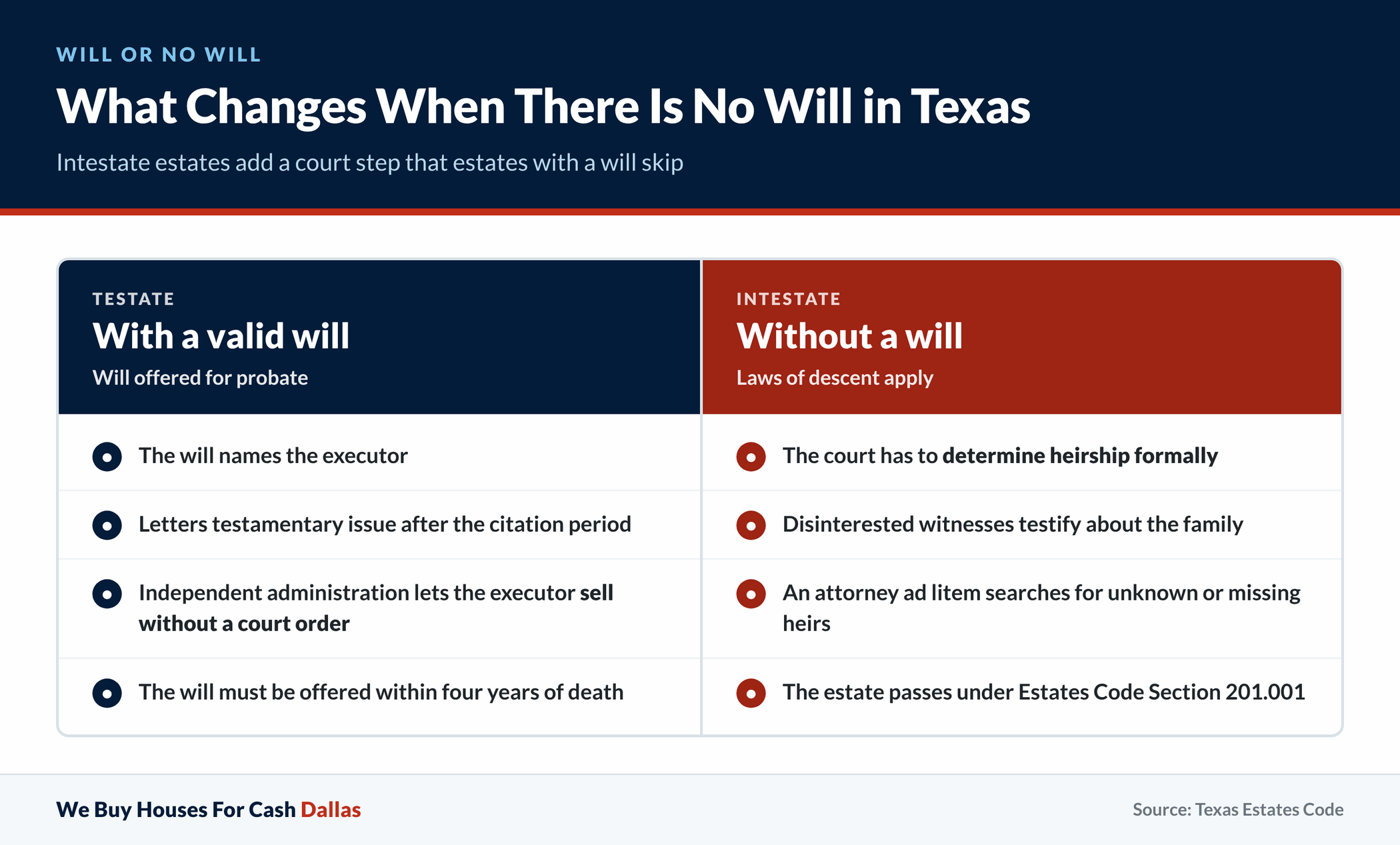
Does intestate probate take longer, then? Usually, though not by much when the family is small and nobody argues.
Blended families are where the timeline stretches. Community property and separate property follow different rules. Children from an earlier marriage can inherit a different share than the surviving spouse’s own children do. A surviving spouse’s homestead right may block a sale even when the kids own the remainder interest. The Texas State Law Library keeps a plain-language guide to intestate succession and it’s worth reading before you hire anyone.
Dying without a will in Texas doesn’t stop the four-year probate clock either. Depending on what the estate owns, an affidavit of heirship or a small estate affidavit may be the cleaner route.
How Long Does Probate Take in Texas?
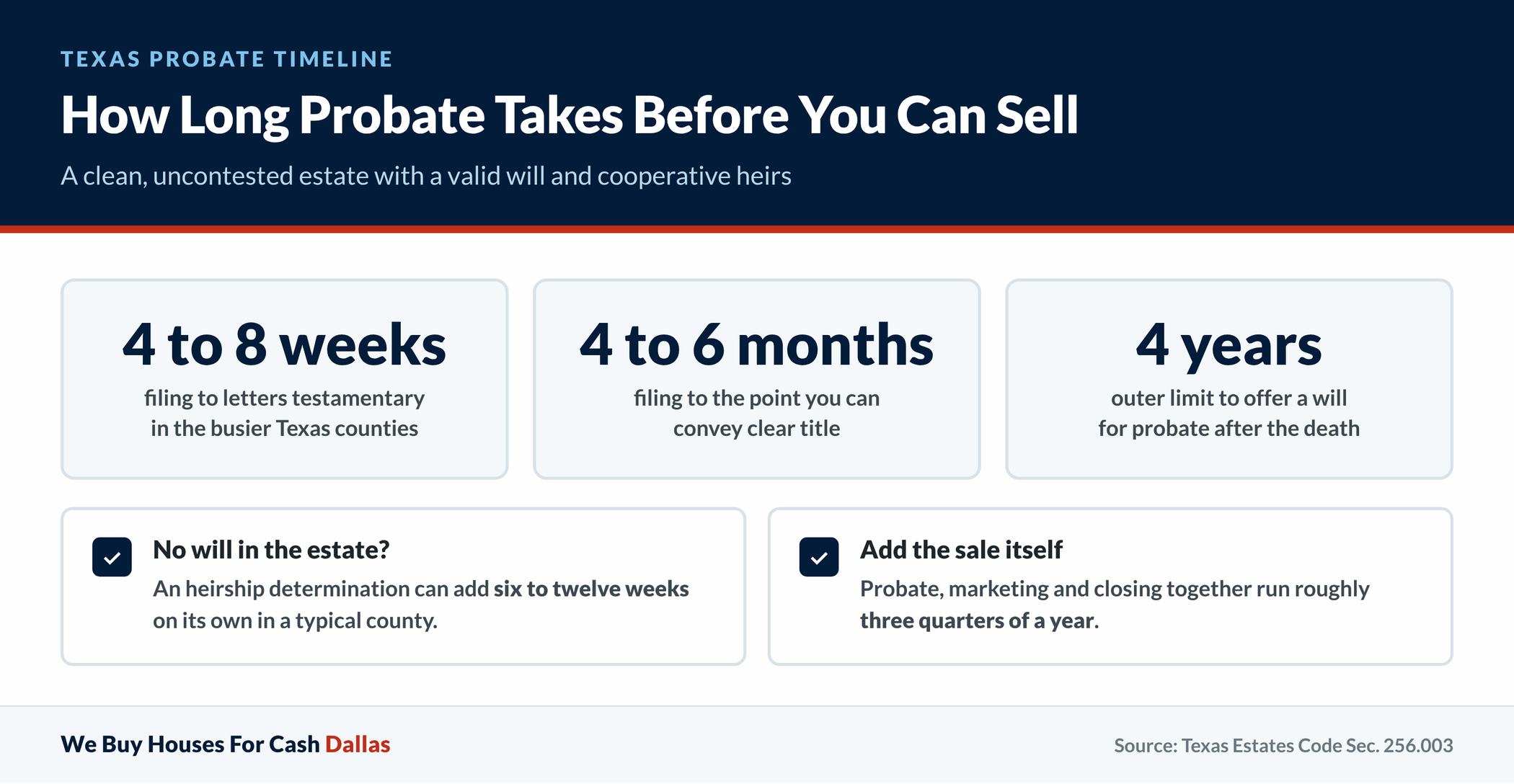
Four years is the outer wall. Under Texas Estates Code Section 256.003, a will generally must be offered for probate within four years of the testator’s death. Courts hold that line firmly, with narrow exceptions. Miss it, and the estate usually passes by intestate succession as though no will existed. That can hand the house to relatives the decedent never meant to include.
For a clean, uncontested Texas estate with a valid will and cooperative heirs, figure four to six months from filing to the point where you can convey clear title. In the busier Texas counties, letters testamentary often issue four to eight weeks after filing. Both depend on the court’s docket cooperating and the citation period running out with no objection.
Now lay the probate timeline over the market timeline, because together they decide whether you carry this house through another summer. Redfin put the Dallas metro’s median sale price at $406,529 for January through June 2026, down 2.2 percent from a year earlier. Homes there took a median of 65.6 days to sell. A vacant inherited house competes with move-in-ready listings on those same streets. Buyers notice the dated kitchen and the overgrown yard long before they notice the price, and every week on the market is another week of carrying costs.
Five months of probate, two and a half months of marketing and a month to close adds up to roughly three quarters of a year. Taxes, insurance and lawn care keep piling up on a house nobody lives in.
How Long Does an Executor Have to Settle an Estate in Texas?
No single deadline tells the person in charge when an estate has to be closed. The Estates Code sets milestones along the way instead.
Within a month after letters issue, you publish notice to creditors in a local newspaper. By the two-month mark, each secured creditor gets notice by certified or registered mail. Beneficiaries named in the will get notice within 60 days of the order admitting it to probate. Then comes the inventory, appraisement and list of claims, or a permitted affidavit in lieu of the inventory.
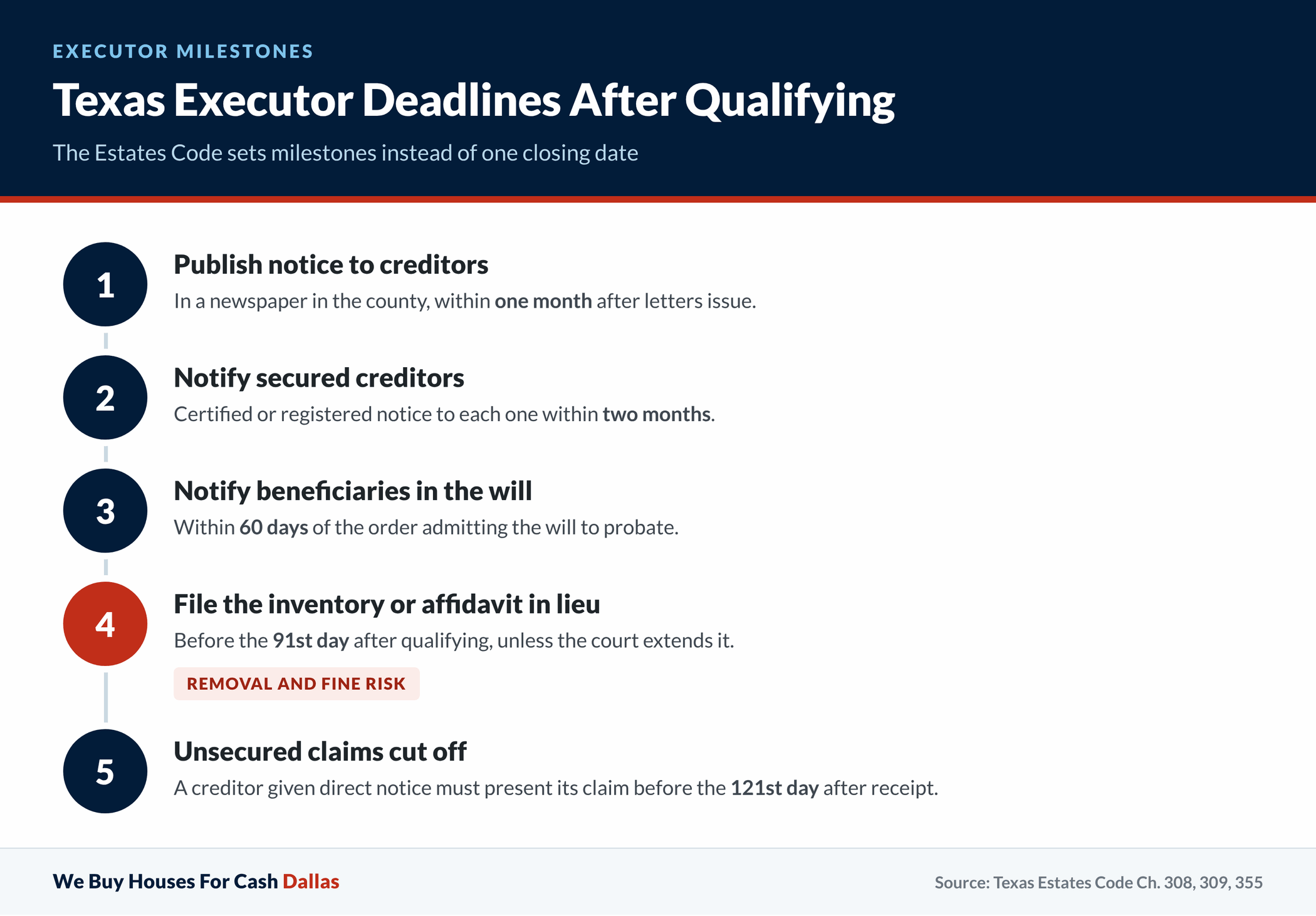
That inventory deadline has teeth. Under Texas Estates Code Section 404.0035, an independent executor can be removed for failing to file the inventory and list of claims, or an affidavit in lieu, before the 91st day after qualification. A court order extending the deadline moves that date. Bexar County’s probate instructions add that a judge can fine them up to $1,000 under Section 309.057 after citing them for not filing. Ask your own county clerk whether it hands out a similar list.
Can you sell the house before the inventory is on file? In an independent administration, generally yes. An independent administrator holds the same power to sell real estate that a dependent one has, without asking the court first. Your title company will still want to see the letters and the order.
Executors who treat these dates as suggestions tend to end up at a hearing, explaining themselves to a Texas probate judge.
What Happens During Texas Probate After You Sell a House?
Sale proceeds belong to the estate, not to you. The money lands in the estate’s account rather than your personal checking, and your Texas probate file should show the sale.
Creditor claims explain the wait. Publishing notice puts creditors on alert. A separate rule covers an unsecured creditor that gets notice directly: under Section 355.060, its claim is barred unless presented before the 121st day after it received that notice.
Mortgage payoffs, property tax prorations and any liens come out at closing. Texas property taxes on an inherited house don’t pause for probate, and an unpaid balance follows the property into the sale.
Probate attorneys, appraisals, filing fees and upkeep on the property all get paid before anyone sees an inheritance check.
I see the same pattern across Texas estates. The family sells the house, then the probate stalls for months because nobody wants to tell the court the estate is ready to close. Paperwork sits untouched, and interest on the estate’s remaining debts keeps adding up. If you’re the executor, finish the file.
Fewer repair invoices mean fewer estate expenses to account for. Selling for cash to a buyer like We Buy Houses For Cash Dallas keeps the accounting simple enough to wrap up the probate without a second meeting with the attorney.
What Happens When Heirs Dispute a Will During Probate?
A Fort Worth family I worked with had three siblings ready to sell and one holdout in Colorado who hadn’t spoken to their father in a decade. She filed an objection the week before the hearing. After that the house sat empty for eleven more months, through a Texas winter and a Texas summer.
One objection like that turns a four-month probate into a lawsuit. Discovery, depositions, expert testimony about capacity and a probate judge’s trial calendar all stack up.
Can the house sell while the heirs fight? Sometimes, when the court authorizes it or the parties agree. Vacant houses lose value, and every lawyer in the room knows it.
Partition suits are the other kind of fight. They come up in Texas families who inherited property together years ago and never cleared title. One cousin wants out while four want to keep it, and that one cousin can still force a sale through the district court.
From what I’ve seen, mediation settles far more Texas will contests than trials do. It costs a fraction of probate litigation, and it gets the property to market while it’s still worth something.
Meanwhile the empty house faces copper theft, pipes that burst in a hard freeze and small repairs that grow into big ones. Insurance carriers also cancel policies on houses left unoccupied.
What Mistakes Delay Probate and Cost Executors More Money?
“Do I really need a lawyer for this?”
In Texas, most probate courts effectively require one. An executor speaks for everyone with an interest in the estate, not just for themselves. Filing pro se in a Texas statutory probate court usually ends with a rejected application and a few lost weeks.
Losing the original will is the most expensive error. When the original was last in the testator’s hands and can’t be found, Texas law presumes the testator destroyed it on purpose. A photocopy won’t overcome that alone. It takes testimony, affidavits and a hearing.
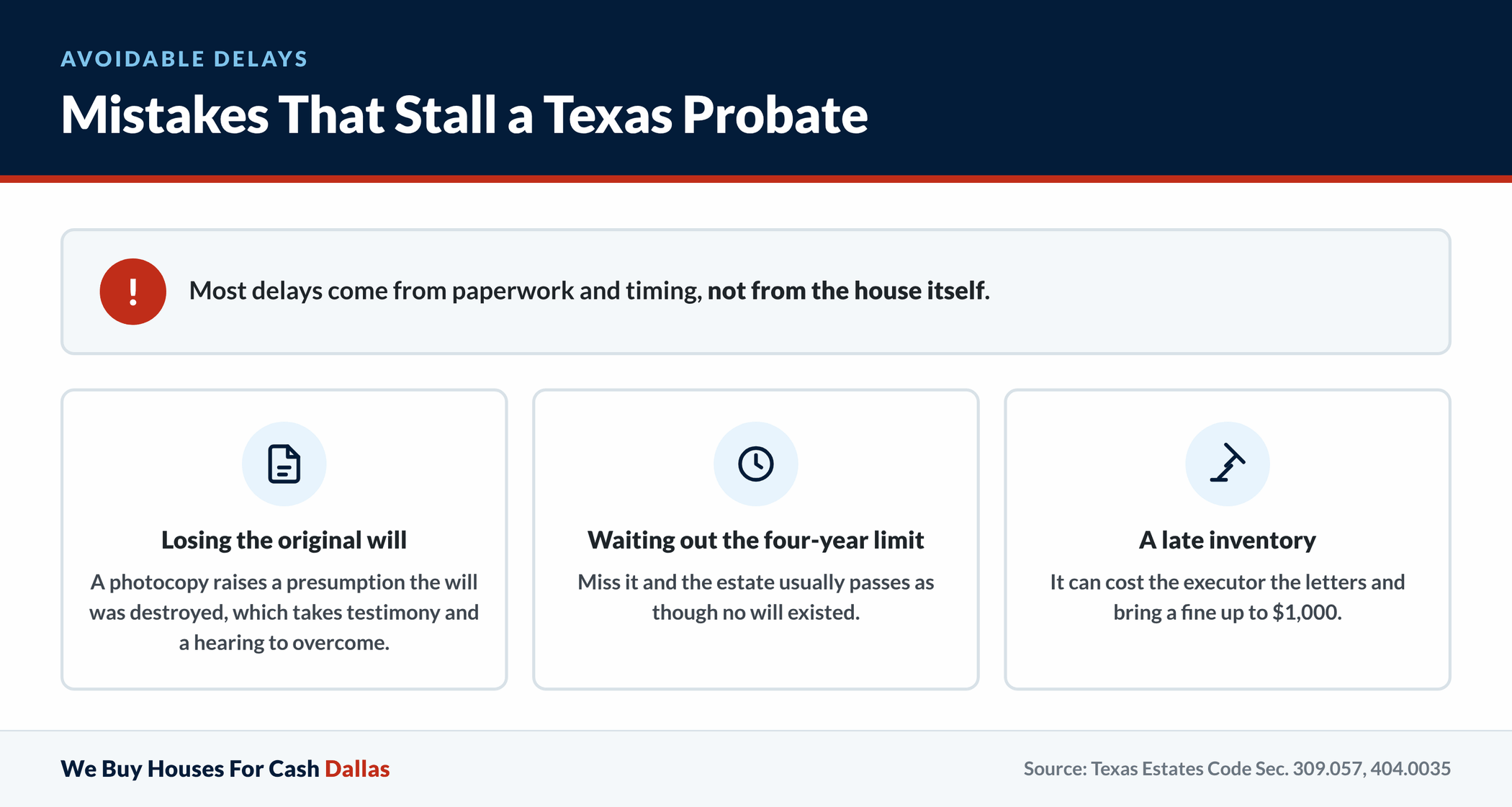
Families grieve, and the house sits. Three years later somebody notices the four-year wall is eight months off. It rarely bends, and every month of delay keeps the assets frozen.
Incomplete probate inventories get sent back. Skipping a required notice to the Comptroller leaves a gap in the file. Underinsuring a vacant Texas property means a denied claim, and the estate absorbs the loss.
Pricing the house for the market of three years ago isn’t a probate mistake. It’s a money mistake that drains the estate just the same. Texas REALTORS reported a statewide median price of $340,000 for the second quarter of 2026, unchanged from a year earlier. Homes stayed on the market 65 days on average, and inventory sat at 5.4 months of supply. With that much competition, an overpriced inherited house sits, and the estate pays to carry it.
What Does the IRS Estate Tax Closing Letter Mean for Probate?
“My aunt’s house is worth four hundred thousand, so we’ll owe federal estate tax, right?” Almost certainly not. That worry holds up more Texas probate files than any real tax bill does. For deaths in 2026, the executor files Form 706 only if the gross estate plus adjusted taxable gifts exceeds $15,000,000. Nearly all Texas estates fall far below that line and never file the return, so the closing letter has nothing to do with their probate.
Texas has no state estate tax and no inheritance tax. An estate under the federal threshold has nothing to wait for from any revenue department.
For the rare Texas estate that does file, the order of events shapes your timeline. Estate and generation-skipping taxes are due within nine months of the date of death. The IRS issues a closing letter only when you request it through Pay.gov. It also asks you to wait at least nine months after filing Form 706 before you make that request. An executor who insists on the letter before distributing anything keeps the estate open a long time.
There’s a free alternative, too. Notice 2017-12 says an IRS account transcript can stand in for Letter 627, the estate tax closing letter. A transaction code of 421 on that transcript confirms the IRS examination is closed. The estate tax FAQ the IRS keeps lists the current fee and procedure, and that fee has changed more than once.
Whether to ask for the letter at all is a planning choice, not a probate requirement. It shouldn’t hold up a house sale.
A seller in Mesquite had quietly covered two mortgages for almost a year, her own and her late father’s. She hadn’t told her brothers because she didn’t want to seem like she was pushing them. The garage gave it away: his retirement boat still sat on its trailer, the registration two summers expired. We closed in under three weeks once the Texas probate letters were in hand. Afterward she told me the relief hit her in the parking lot.
Frequently Asked Questions About Probate in Texas
What Is the Statute of Limitations to Probate a Will in Texas?
The Texas Estates Code gives you four years from the date of death, the window described earlier in this article. After that, the court generally treats the estate as though no will existed. There’s an exception when you can show the delay wasn’t your fault, though proving it is a real evidentiary burden. Even when a Texas court accepts a late will, it usually admits it as a muniment of title rather than appointing an executor. You get a document that clears title, without full administrative powers.
Who Legally Owns the Home While Probate Is Pending in Texas?
Under Texas law, title passes to the heirs or beneficiaries the moment the owner dies. That title is still subject to the estate’s debts and to the personal representative’s authority over the property. In practice, you can’t sell until the probate court issues letters or admits the will, because no title company in Texas will insure the sale without that paperwork. You carry the taxes, insurance and upkeep in the meantime, which is why a long probate delay gets expensive.
What’s the Average Cost to Probate a Will in Texas?
Nobody can give you a figure without knowing what the estate owns, because costs vary by county and by complexity. A simple independent administration in a Texas county with cooperative heirs sits at the low end. An heirship determination with an attorney ad litem, or a will contest, can cost several times as much. Your county clerk’s office can tell you the current filing fees, and many Texas probate attorneys will quote a flat fee for an uncontested case if you ask.
Can I Sell an Inherited Texas House Before Probate Is Finished?
In an independent administration, usually yes, once letters have issued and your title company is satisfied. You don’t have to wait for the estate to close or for every creditor claim period to run out. The proceeds stay with the estate until its debts are settled, though. Cash buyers tend to be easier to work with here than financed buyers, since lenders get nervous about anything with a probate order attached.
Does Probate in Texas Take Longer If the House Needs Repairs?
Repairs don’t lengthen the probate itself. They lengthen the sale. An inherited Texas house with a failing roof or thirty years of deferred maintenance either sits on the market or draws low offers from buyers who build in a wide margin. Selling as-is to a direct buyer takes that variable away, and it keeps the estate from spending on improvements the executor may struggle to justify to the other heirs.
Do All Texas Estates Have to Go Through Probate?
No. Small estates may qualify for a small estate affidavit, and some property passes by beneficiary designation or survivorship. In some situations, an affidavit of heirship can clear title on a homestead without a full probate proceeding. A Texas probate attorney can usually tell you in one conversation which path fits, and picking the lighter one saves months.
If you’re holding an inherited house in Texas and can’t decide whether to wait out the probate or move now, we’re glad to talk it through. Plenty of Texas executors and heirs have worked with us, and sometimes the right answer is to list with an agent once the court clears things. Either way, you’ll get a straight read on your options from We Buy Houses For Cash Dallas, with no pressure and nothing owed for the conversation.
Inherited Houses We Buy in Dallas and Across Texas
Redfin’s figures put the metro’s housing supply at 4.9 months for the first half of 2026. That means an inherited house priced right still has plenty of listings to compete with. We buy houses across Dallas, Fort Worth and the nearby North Texas cities, including houses still working through probate.
Talk With Us About Your Inherited House
If the probate letters are on the way or already in hand, we can walk you through what a sale would look like on your timeline. You can reach out to our team or fill out the form below, and there’s no obligation either way.