
A seller in Oak Cliff called me last spring convinced she’d lose a third of her sale price to the government. She’d been reading about taxes in California. Her actual bill came to zero dollars in state tax and zero in federal tax, because Texas doesn’t tax the gain and her profit landed under the federal exclusion. This conversation happens more than you’d guess, and confusion about taxes costs people sleep they don’t need to lose.
What Taxes Do I Have to Pay When I Sell My House in Texas?
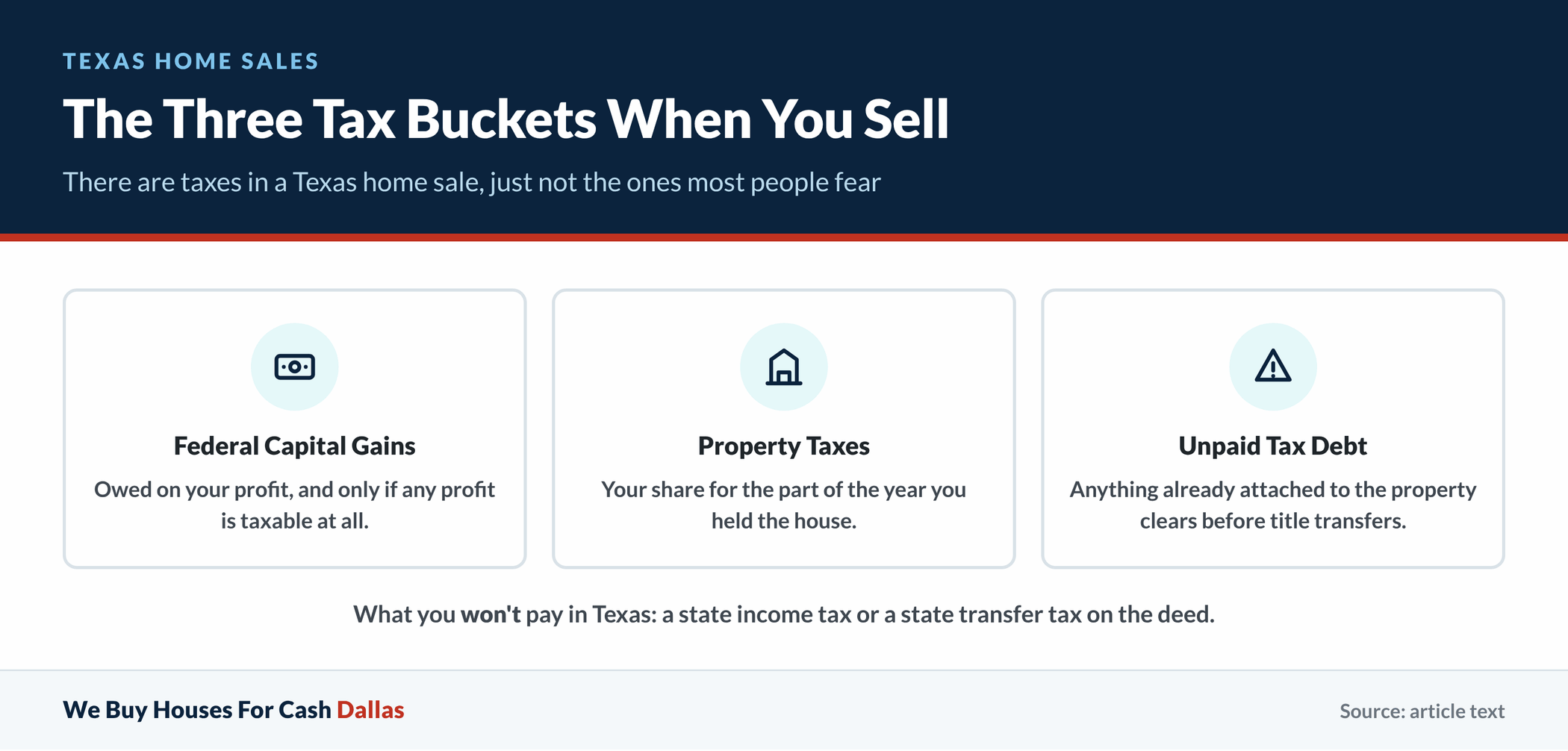
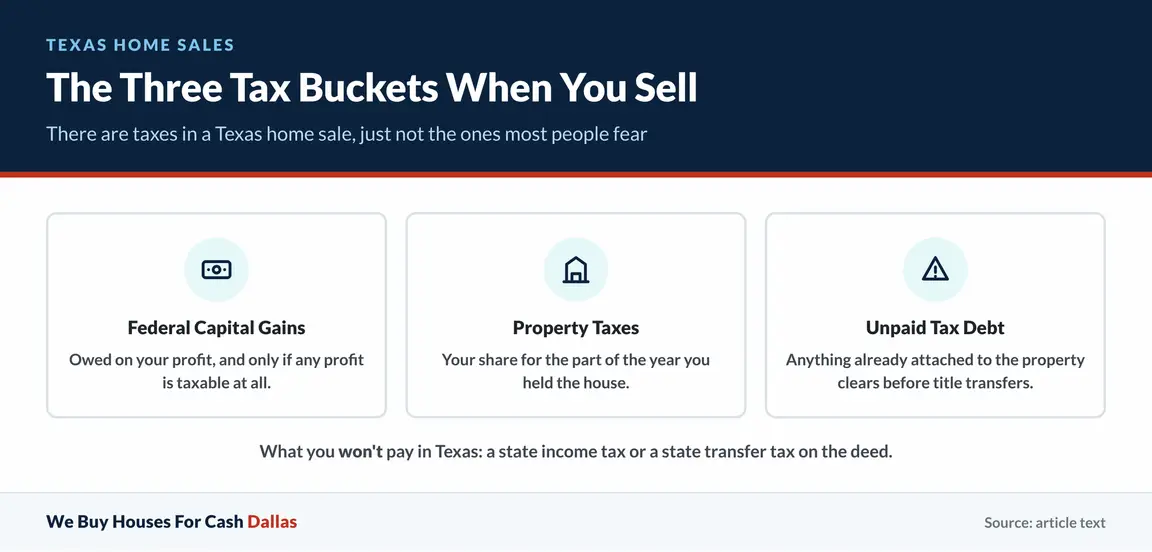
For years I told sellers that Texas was a “no tax” state at closing, which is sloppy shorthand and I’ve stopped saying it. The accurate version: there are taxes in a Texas home sale, they’re just not the ones people fear.
There are three buckets to sort here. Federal capital gains taxes on your profit, if any profit is taxable at all. Property taxes owed for the portion of the year you held the house. And any unpaid tax debt already attached to the property, which has to clear before title transfers.
What you won’t pay in Texas is a state income tax or a state transfer tax on the deed. The Texas Comptroller’s own guidance is blunt about the first part: there’s no income tax imposed by the state or its political subdivisions. So wages, interest, dividends, and capital gains collected by an individual aren’t subject to any Texas state or local income tax. Sellers in California don’t get this break.
A few years back a young couple in Rowlett was splitting assets in a divorce and wanted the house gone before the decree was final. They’d already moved the furniture out, so all that was left was a weight bench in the garage and a stack of unopened property taxes notices on the counter. We closed in under three weeks, split the proceeds per their agreement, and nobody paid a dime in state tax on the gain.
Closing costs are a separate animal from taxes, and sellers mix the two up constantly. Title policy premiums, escrow fees, and agent commissions come out of your proceeds, though none of those are taxes. Keep them in different columns on your worksheet so you can see what’s going to a government and what’s going to a service provider.
How Does Federal Capital Gains Tax Apply to Texas Home Sellers?
“If I made $90,000 on this house, do I owe the IRS taxes on it?”
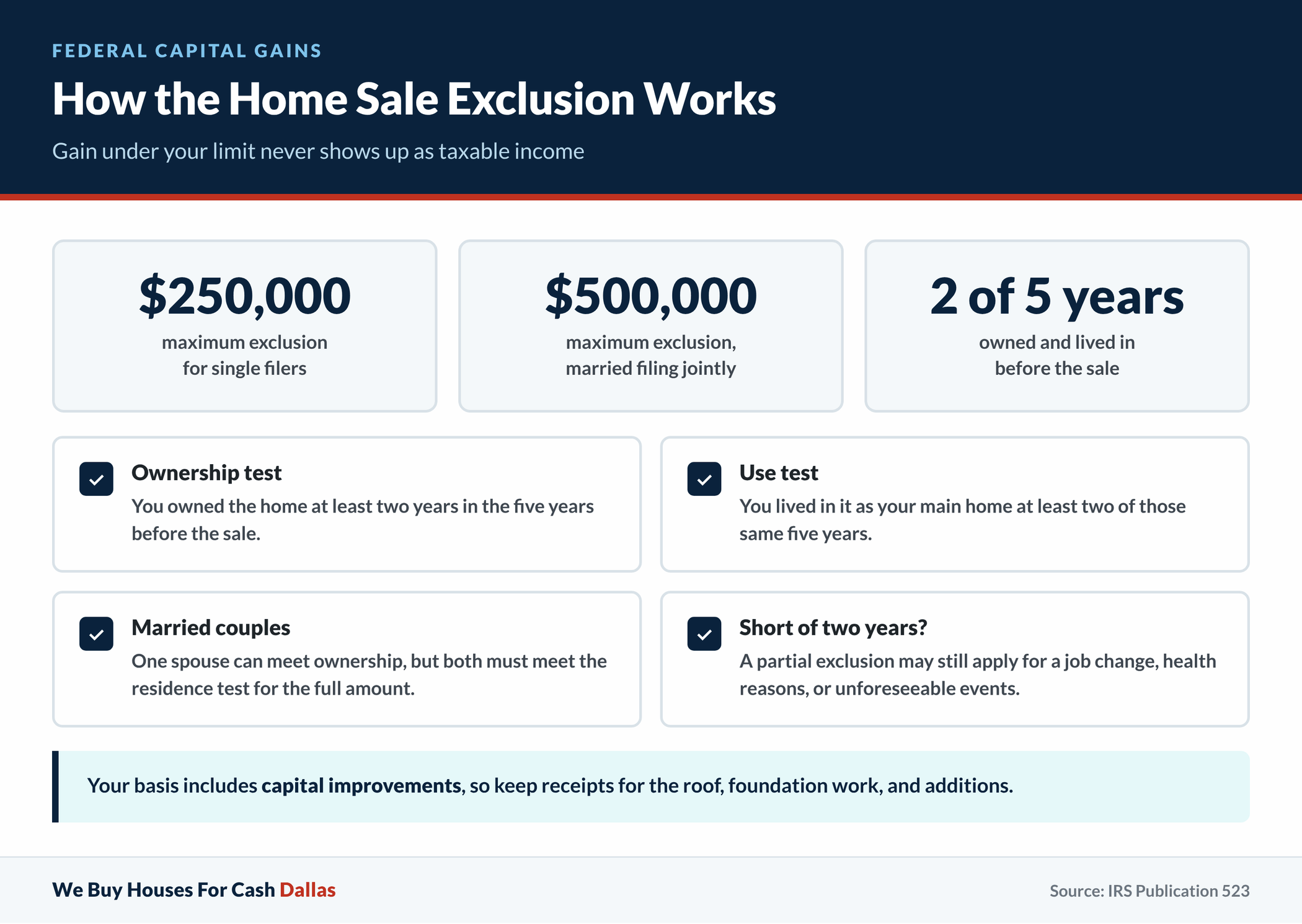
Probably not, and the reason is Section 121 of the tax code. The IRS eligibility test determines whether you qualify for the maximum exclusion of gain, which is $250,000 or $500,000 if you’re married filing jointly. Gain under your limit never shows up as taxable income. You can read the rules straight from the source at IRS Publication 523.
You need to pass two tests to qualify. You must have owned the home for at least two years during the five-year window ending on the sale date. You must have used it as your principal residence for at least two of those same five years. Married couples get a twist worth knowing: only one spouse needs to satisfy the ownership test, but both have to individually meet the 24-month residence requirement to claim the full exclusion.
Gain isn’t the same thing as your sale price minus your original price. Your basis includes what you paid plus capital improvements, things like the new roof after a hailstorm, the foundation piers, the room addition. Selling costs come off the top too. Sellers who kept receipts almost always owe less in capital gains taxes than they projected.
Rental property plays by harsher rules. Depreciation you claimed over the years gets recaptured, and the primary-residence exclusion won’t shelter it. If the house was a rental for part of the time you owned it, a CPA earns their fee on that year’s taxes.
Does Texas Charge a State Capital Gains Tax on Home Sales?
No, and nobody in Austin can add one next session without going through voters first.
It’s locked down because the Texas Constitution, amended by Proposition 4 in 2019, bans an individual income tax. Because capital gains are a form of income, there’s no return in Texas where a gain could even be reported. Since there are no state brackets and no state holding-period rules, your Texas capital gains taxes come out to zero whether you held the house eleven months or eleven years.
What does Texas charge instead? Property taxes, and they’re steep. Statewide averages run roughly 1.6 to 1.8 percent of assessed value. This is part of the trade the state made when it skipped an income tax. So sellers in Plano and Katy feel those taxes every January.
Market context matters when you’re sizing up your gain. Dallas home prices rose 7.8 percent over the three months ending October 2026, hitting a median sale price of $461,000. Houston went the other direction in that same stretch, with prices down 5.5 percent to a $330,000 median and homes taking 54 days to sell versus 49 a year earlier. Two metros, four hours apart, pulling opposite directions.
Appreciation of that size in North Texas pushes long-held homes closer to the federal exclusion ceiling than people track. Somebody who bought in Lakewood two decades ago may genuinely have taxable gain now, which means that’s the one case worth double-checking. For most Texas sellers, though, the only check for taxes goes to the county, not the IRS.
What Tax Exemptions Lower What You Pay When You Sell?
Sellers walk in thinking the homestead exemption shields their sale profit. It doesn’t do that at all. A homestead exemption trims the taxable value used for your annual property taxes; it has nothing to do with capital gains taxes on the sale itself. Two separate systems, two separate offices.
The exemption that does shelter sale profit is the federal one covered above, and partial relief exists for people who fall short of the two-year mark. Partial exclusion safe harbors apply for work changes, health reasons, and unforeseeable events. A job transfer from San Antonio to Denver after fourteen months isn’t automatically a lost exemption.
Divorced and widowed sellers qualify for their own carve-outs. A surviving spouse may be able to use the joint exclusion amount if the sale happens within two years of the death and other conditions are met. In divorces, ownership and use periods can be attributed between former spouses depending on how the decree reads. Have your attorney look at this before signing a property settlement, since the order’s wording can cost or save real money in taxes.
Which records do you still have from the year you remodeled? Improvement receipts reduce your taxable gain, so a shoebox of invoices from the kitchen redo is worth digging out of the attic. Permits, contractor contracts, and credit card statements all help reconstruct basis when receipts are gone.
Investors have the 1031 exchange, which defers federal taxes on an investment property by rolling proceeds into a replacement property. It doesn’t apply to your primary residence, and the deadlines are strict enough that a qualified intermediary needs to be lined up before closing. For a landlord selling one duplex in Garland to buy two in Arlington, it’s the cleanest tool available.
What Property Taxes Are Owed at Closing in Texas?
Property taxes are the only taxes most Texas sellers truly feel, and they’re settled at the closing table whether you’ve budgeted for them or not.
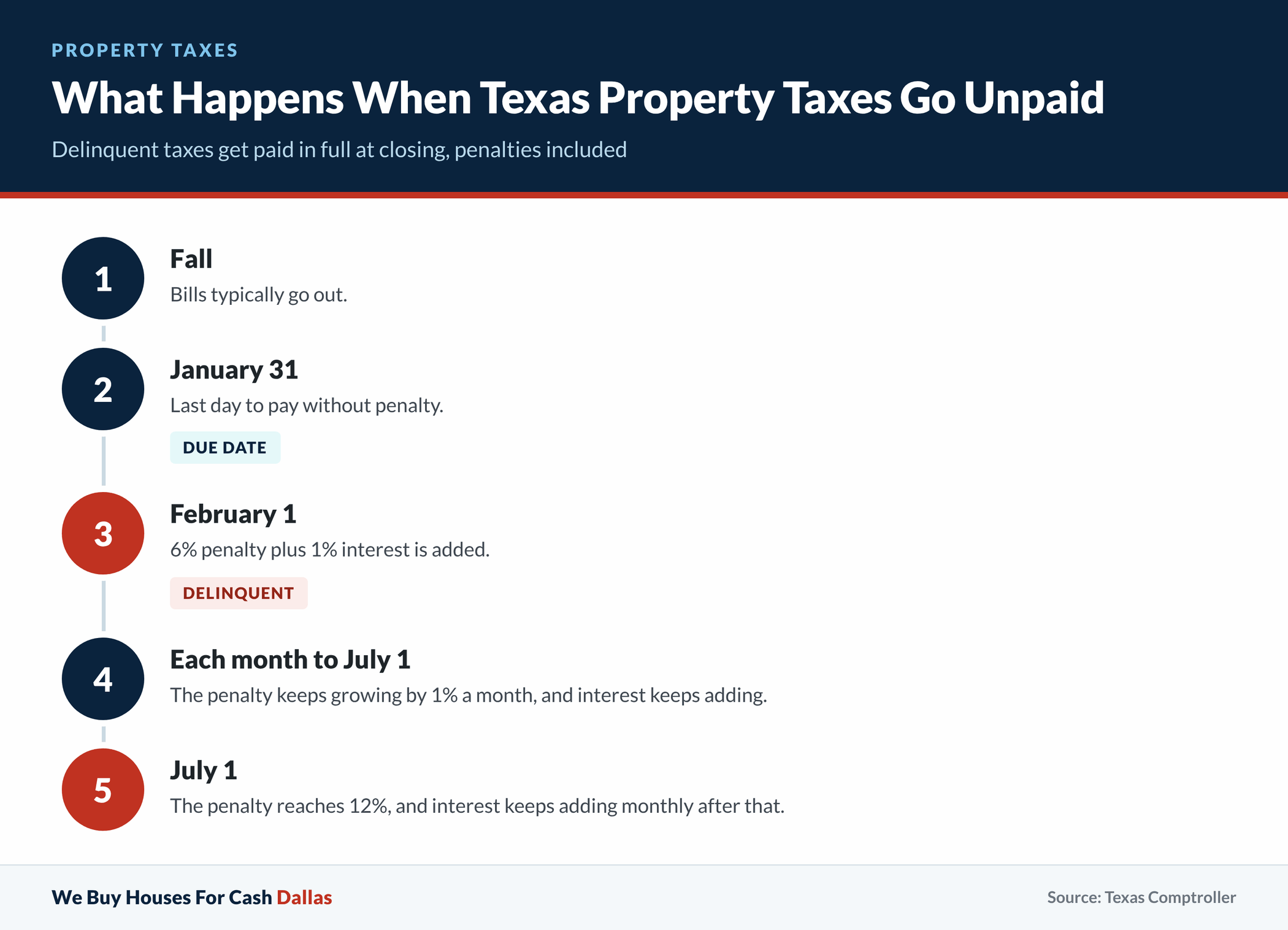
Texas works on an annual cycle, with bills typically going out in the fall and due by January 31. Anything unpaid on February 1 is delinquent, and the Comptroller’s payment guidance spells out what follows. A six percent penalty plus one percent interest is added on February 1. The penalty then grows one percent a month until July 1, when it reaches 12 percent. Interest keeps being added monthly past that point.
Sell in June and your share of the current year’s taxes hasn’t even been billed yet. The title company handles it anyway by estimating the bill and holding your portion from proceeds.
Any taxes already delinquent get paid in full at closing, not prorated. Penalty and interest come out too. For a seller who’s two years behind, that’s the single biggest line item on the settlement statement, and it’s the one I see shock people when they read the draft.
Owners who’ve been sitting on delinquent taxes sometimes prefer a direct sale for exactly this reason. The buyer’s title company clears the county debt from proceeds, and the seller walks away without writing a check. We handle that routinely at We Buy Houses For Cash Dallas, and the arithmetic is usually friendlier than another year of penalties stacking.
Mortgage escrow adds a wrinkle. If your lender has been collecting monthly for taxes, that escrow balance gets refunded separately after payoff, typically within weeks. Don’t count it as part of your closing proceeds.
How Are Prorated Taxes Calculated on a Texas Sale?
A seller in Pflugerville closed on October 15 expecting to pay a full year of taxes at the table. Instead her settlement statement showed a credit to the buyer covering roughly nine and a half months, and her net came in higher than she’d penciled.
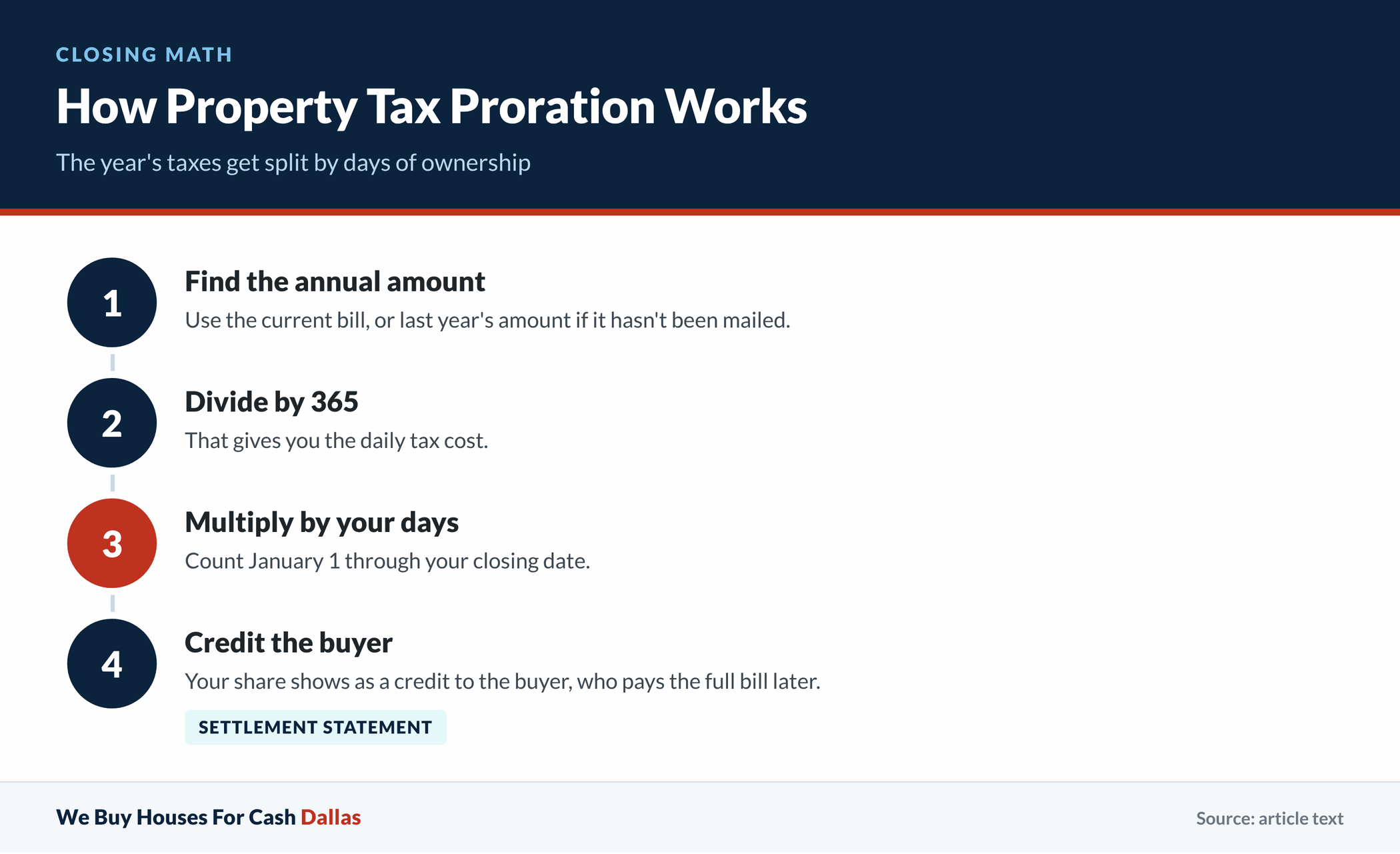
Proration splits the year’s property taxes by days of ownership. You cover January 1 through your closing date; the buyer covers the rest and pays the whole year’s taxes when the bill arrives. In Texas, that credit usually flows from seller to buyer because the taxes come due at the end of the year, after you’re gone.
The math itself is simple division. Take the annual tax amount, divide by 365, multiply by the days you owned the house. Title companies run it automatically, but check their number against your own. I’ve caught prorations built off a prior year’s bill when the current assessment had jumped.
Which figure does the title company use when the current year’s bill hasn’t been mailed? Most estimate from last year’s taxes, with the contract spelling out whether anyone re-prorates after the real bill lands. Read that clause. If your county appraisal district raised your value in the spring, last year’s number understates what the buyer will owe.
Exemption changes complicate things further. When you sell to someone who won’t qualify for your over-65 exemption, the buyer’s eventual taxes climb, and the estimate used at closing may be low. Some contracts handle this with a re-proration agreement; many don’t.
Your county tax assessor-collector’s office can confirm the exact current-year amount and any exemptions still on the account. One phone call before closing beats a surprise later. Statewide, homes have been taking longer to move through contract, so build that call into a timeline that already includes a few weeks of escrow.
Can Back Taxes Stop You From Selling a Texas House?
A tax lien in Texas attaches to the property on January 1 of each tax year, before a bill is ever mailed. That’s why delinquent taxes travel with the house and why no title company will insure around them.
Selling is still absolutely possible. Liens get paid from proceeds at closing, same as a mortgage payoff. Trouble starts when the back taxes exceed your equity, because then somebody has to bring cash to the table or negotiate.
Attorney fees are the part that turns a manageable debt into a crisis. Under the Texas Tax Code, accounts delinquent between February 1 and May 1 that remain unpaid on July 1 can pick up an additional penalty for attorney fees of up to 20 percent. That additional penalty applies only where the taxing unit has contracted with a private attorney for collection, and only after the tax office mails a notice before July 1. I’ve seen owners get blindsided by this because they assumed the original penalty was the whole story, so ask your county clerk or tax office for the exact figure on your account today.
Federal tax liens from the IRS and state liens for unpaid franchise or sales taxes behave differently from property taxes but create the same closing problem. Title has to clear. An IRS lien can sometimes be discharged from a specific property so a sale can close, and that paperwork takes weeks, not days.
A landlord in Mesquite called me on a Thursday about a rental he’d owned since the nineties. He was two years behind on taxes, with a contractor estimate for the kitchen that ran past what the kitchen would add in value. He’d already replaced the water heater twice. Selling the house as it stood, with the county paid from proceeds, left him with more in his pocket than the renovation path ever would have. That math repeats itself constantly in older Texas neighborhoods.
Frequently Asked Questions About Taxes When Selling a House in Texas
Statewide, Texas median listing prices sat at $355,765 in September 2026, according to Federal Reserve data. Most sellers at that price point end up with simple tax questions.
How Much Capital Gains Tax Will I Owe on $10,000 of Profit?
On a primary residence where you meet the ownership and residence requirements described earlier, a gain that small is fully covered by the federal exclusion, so your federal capital gains taxes come to nothing. Texas adds no state layer on top. If the house was an investment property instead, that profit is taxable federally, and the rate depends on how long you held it and what your overall income looks like that year.
Which Tax Benefit Allows Married Couples a $500,000 Tax Free Gain on a Primary Residence?
That’s the Section 121 exclusion, the same federal rule laid out in the capital gains section above. Both spouses have to clear the residence requirement individually, though only one of you needs to be on the deed long enough to satisfy ownership. Texas doesn’t offer a parallel state benefit because the state has no income tax for an exclusion to apply against.
How Much Are Property Taxes on a $1,000,000 House in Texas?
Rates vary by county, city, school district, and any special districts your address falls inside, so a million-dollar home in Highland Park and one in Fort Bend County won’t owe the same amount. Applying the statewide average rate cited earlier gets you a rough starting figure, but your appraisal district’s website lists the exact combined rate for your parcel. Homestead, over-65, and disability exemptions all lower the taxable value before that rate is applied.
Do Seniors Have to Pay Capital Gains Tax When They Sell a Home?
Age doesn’t exempt anyone from federal capital gains taxes; the old one-time exclusion for older sellers disappeared decades ago. Seniors use the same ownership and residence tests everyone else does, and most Texas sellers over 65 qualify easily because they’ve lived in the house for years. What age does affect is property taxes, since the over-65 exemption and tax deferral options exist at the county level.
What Happens to My Property Taxes If I Sell Mid-year in Texas?
Your share gets prorated through the closing date and credited to the buyer, who then pays the full bill when the county sends it. You don’t file anything with the county yourself. The title company handles the calculation and the settlement statement shows exactly what came out of your proceeds.
If you’re trying to figure out what a sale would actually net you after taxes, liens, and closing costs, we’re happy to walk through the numbers with you. No pressure, no obligation, and no cost for the conversation. Call or reach out through We Buy Houses For Cash Dallas whenever you’re ready, even if selling is still just something you’re thinking about.
How We Buy Dallas Houses With Back Taxes Owed
We buy houses across Dallas and the rest of Texas, including homes with delinquent property taxes or a tax lien on the title. In Veterans United’s local market data, Dallas metro homes recently spent a median of 64 days on the market.
When the title company pays the county from your proceeds at closing, you don’t have to write a separate check.
Talk With Us About Your Texas Home Sale
If you want to know what a sale would net you after taxes and closing costs, get in touch with our team and tell us a little about the house.
You can also fill in the short form below, and we’ll follow up.