
A buyer once told me he’d waive everything, then asked me what a contingency was. That’s the problem in a nutshell. Offers with no contingencies get thrown around like a magic word, and plenty of sellers accept one without understanding which protections just disappeared from their contract. Sometimes that’s how a sale dies three weeks in, after you’ve already given notice at your apartment and booked the movers.
Let me walk you through what this really involves.
What Does Selling a House with No Contingencies Mean?
“So the buyer just can’t back out?” That’s the first question I hear, and the answer is more complicated than yes.
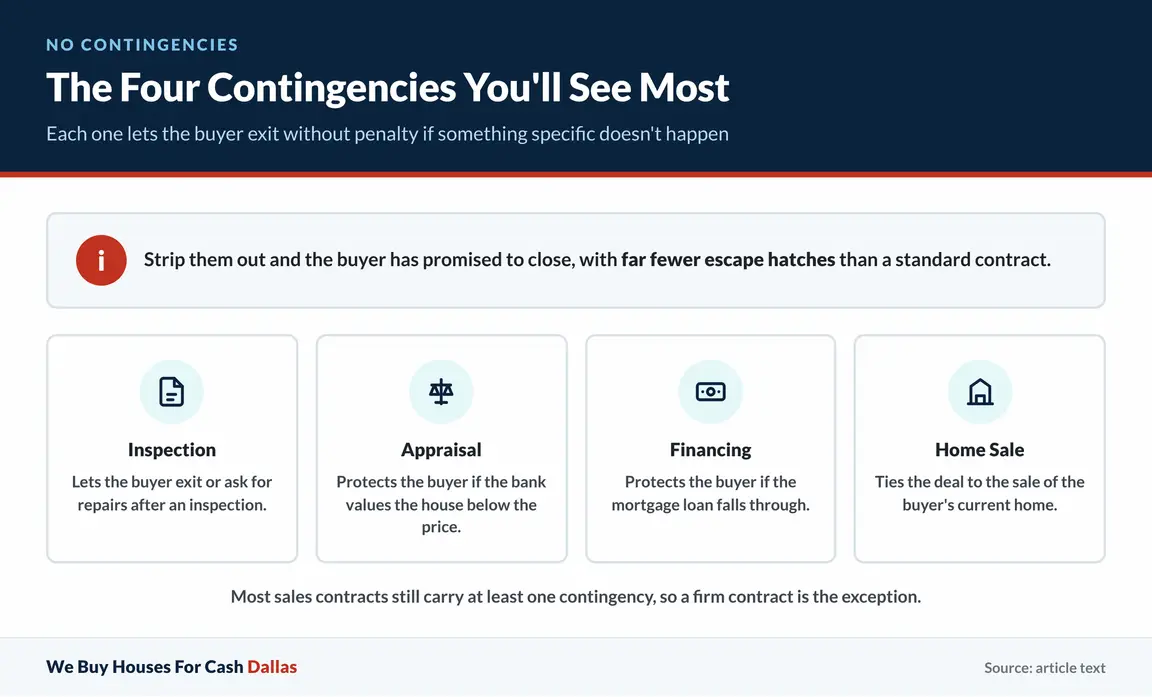
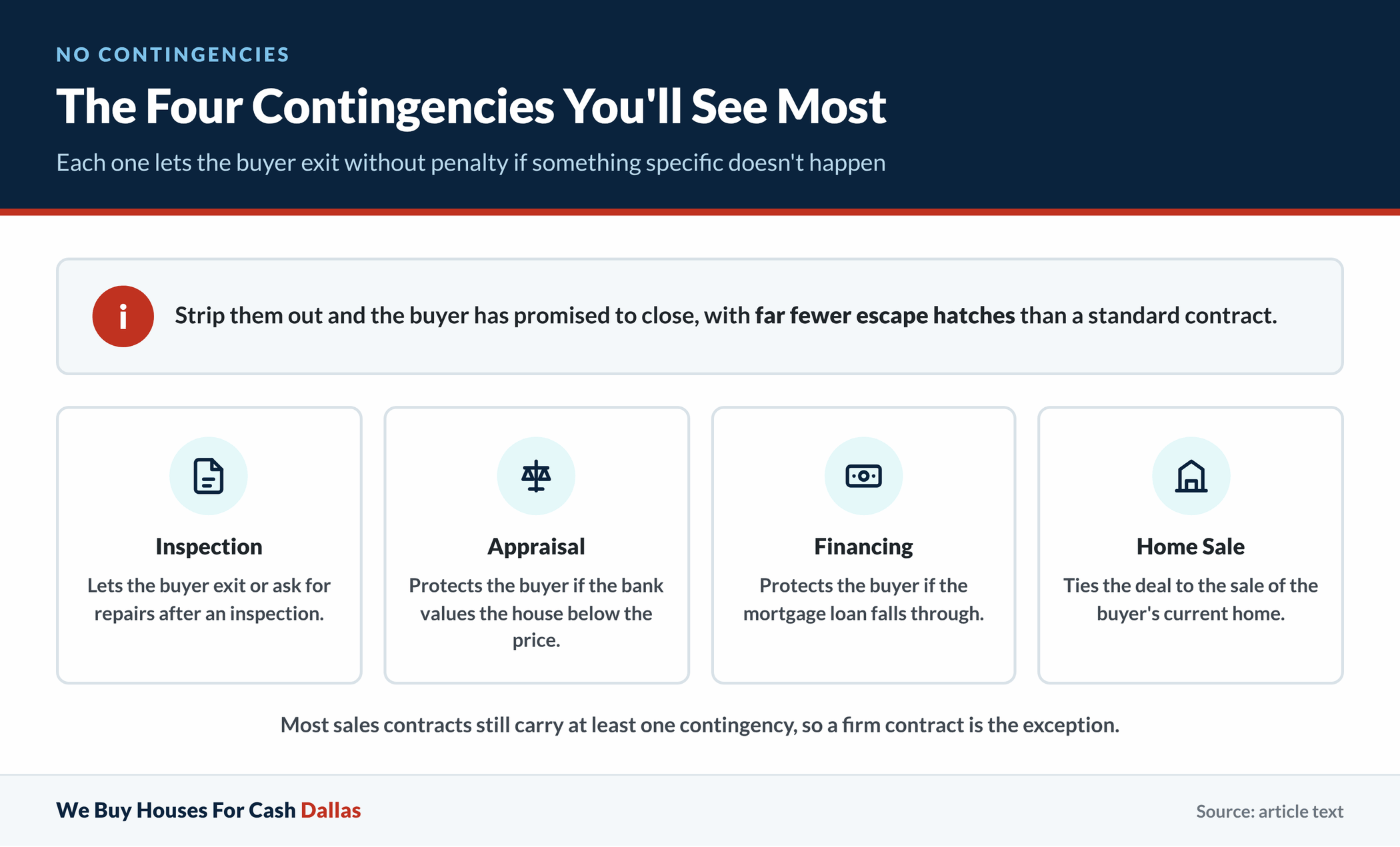
Every contingency is a condition written into your agreement that lets one party exit without penalty if something specific doesn’t happen. Inspection, appraisal, financing, and the sale of the buyer’s current home are the four you’ll run into most. Strip them out and you have an offer with no contingencies: a legally binding agreement where the buyer has promised to close, period, with far fewer escape hatches than a standard contract.
Most sales contracts nationally still carry at least one contingency, so a true no-contingency sale is the exception, not the norm.
What doesn’t vanish? Your disclosure obligations, and title still has to come through clean, since the buyer still gets a walkthrough in most contracts. Depending on your state, there may also be statutory rights no contract can waive. A sale with no contingencies removes the buyer’s conditions, not the law.
Last year I bought a small brick ranch from an heir who’d inherited it and was living a state away in Tulsa. She’d been chasing rent checks for eleven months and never wanted to be a landlord to begin with. So we signed with no contingencies because what she needed wasn’t top dollar; it was a date on the calendar she could plan her life around.
That’s the real trade. You’re swapping a little price for a lot of certainty.
Why Would a Buyer Waive All Contingencies?
In most cases it comes down to confidence, not carelessness. Buyers who waive everything usually aren’t being reckless. They’re pricing the risk instead of papering over it, and that distinction rarely gets explained clearly.
If you already have the information, you don’t need the exit. An investor who’s walked two hundred kitchens knows roughly what a 1970s galley with soft subfloor costs to fix. So that buyer can skip the inspection contingency because the number is already baked into the offer.
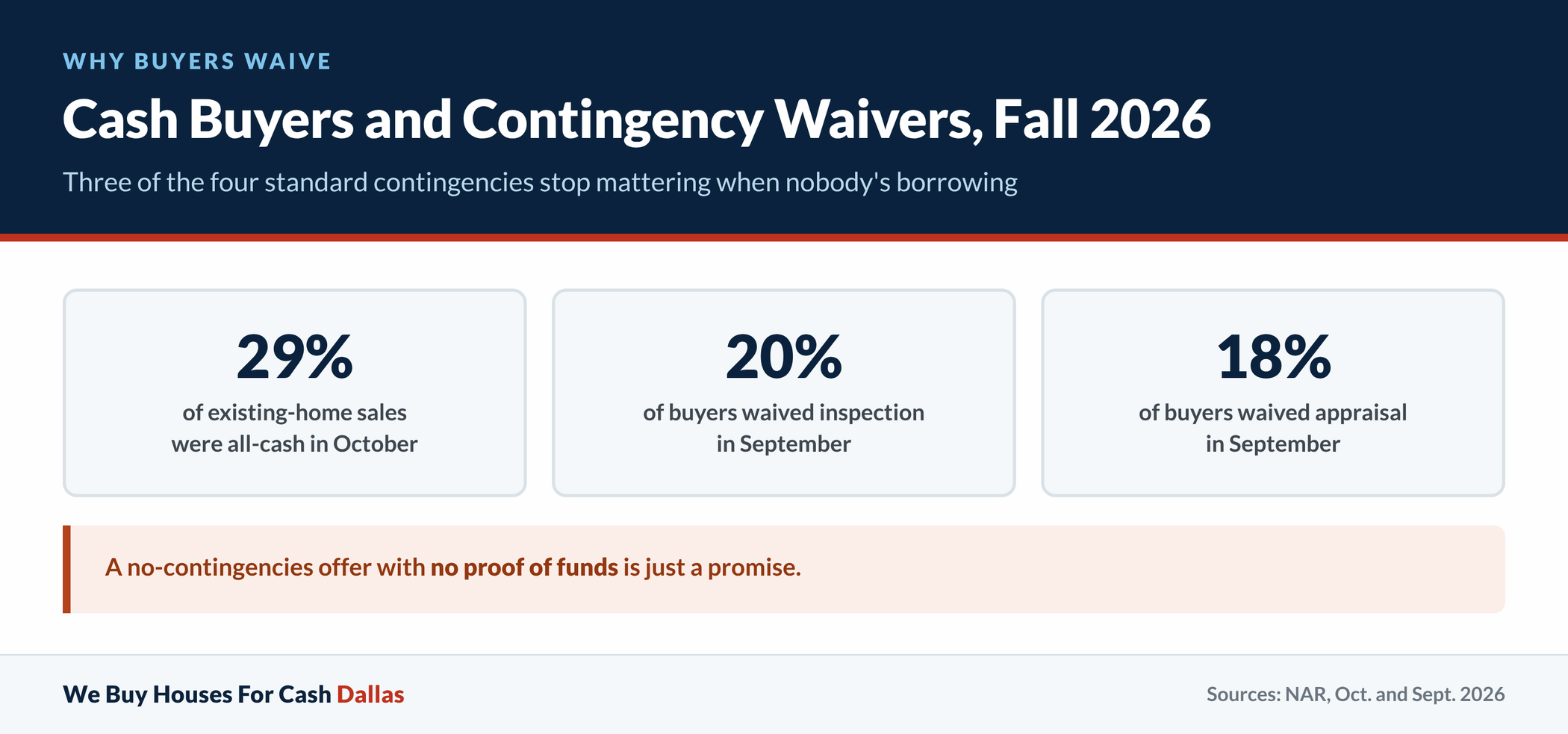
Cash drives the other half of this. In October 2026, all-cash buyers accounted for 29% of existing-home sales, up from 27% the month before. No loan means no lender, no underwriting, no property appraisal ordered by a bank. Three of the four standard contingencies become irrelevant the moment nobody’s borrowing.
Competitive pressure drives the rest. In a bidding war, a buyer who can’t beat someone on price beats them on terms. That’s been true for years, though the waiver rates move with the market. NAR’s September 2026 Realtors Confidence Index showed 20% of buyers waiving the inspection contingency, with 18% waiving the appraisal.
Watch for that one. An offer with no contingencies from someone with no proof of funds is just a promise with extra confidence attached.
How Do No Contingencies Offers Compare to Traditional Ones?
A higher offer isn’t always the safer one. A seller I worked with had two offers on her mother’s house: one for $18,000 more with a standard contract, one lower with no contingencies. She took the higher one. Nine weeks later the buyer’s lender killed it over a debt-to-income recalculation, and she called me from her kitchen floor asking what her options were.
Probability of closing times net proceeds, minus the cost of every month you’re still holding the property, is the comparison that matters.
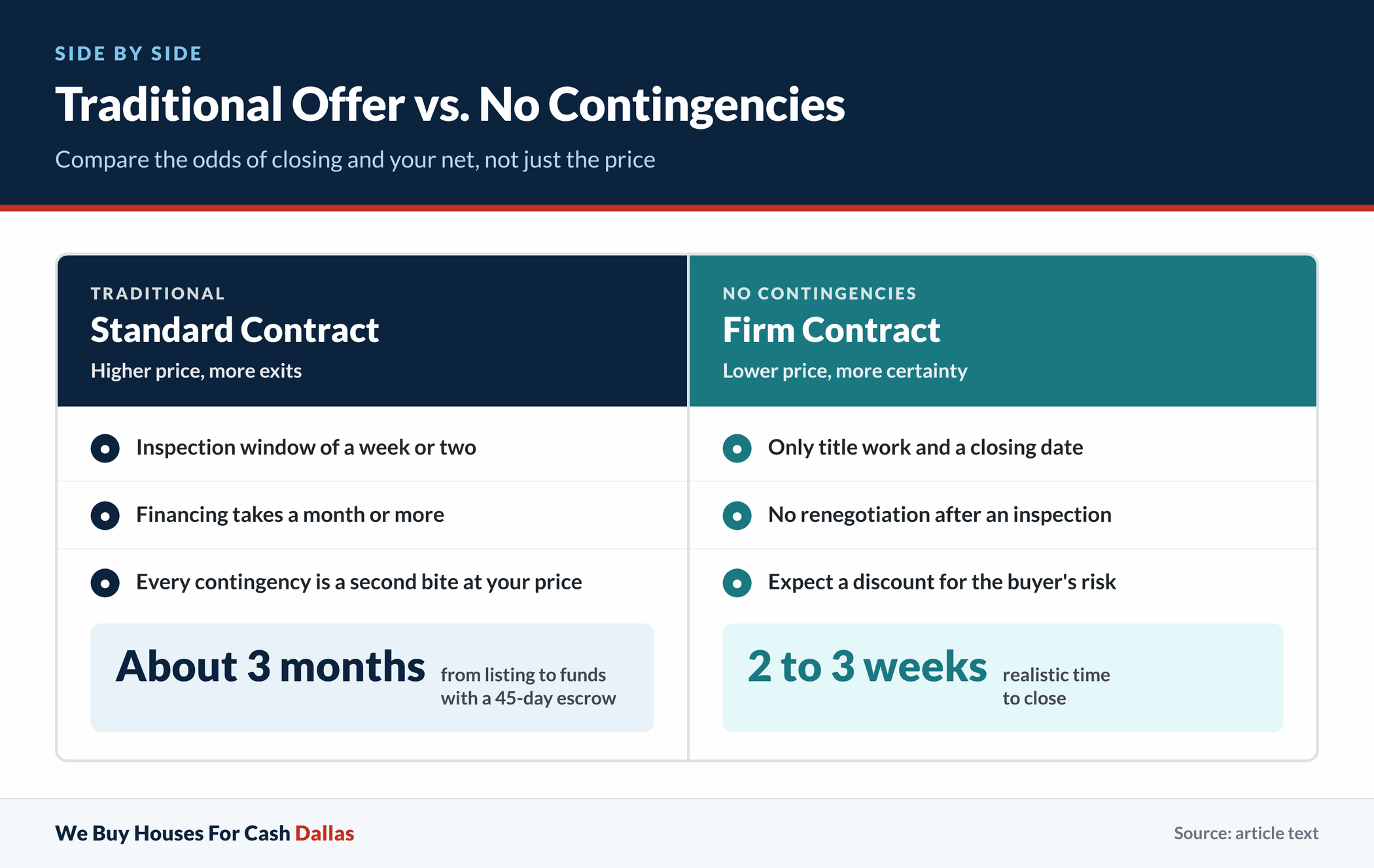
Run the clock on a traditional sale. An inspection window typically runs a week or two. Financing takes a month or more. Layer those on top of the time your house spent listed, and the calendar stretches. Nationally, the median home sat 35 days on market in October 2026, up from 33 in September. Add a 45-day escrow and you’re pushing three months from listing to funds.
Contracts with no contingencies compress that. There’s nothing to wait on except title work and a closing date, so two to three weeks is realistic.
The second difference is renegotiation. Every contingency is a second bite at your price. Inspection findings alone drive the bulk of contracts that collapse or get repriced, and I’ve seen the request often arrive after you’ve emotionally spent the money. An agreement with no contingencies closes that door.
Do you want the highest number, or do you want the number you’ll actually bank? Those aren’t always the same answer, and pretending otherwise does sellers no favors.
What Happens to Inspection and Appraisal Contingencies?
Plenty of sellers hear “waived inspection” and picture a buyer who never looks at the house.
Waiving the contingency isn’t waiving the inspection. Buyers can still inspect for information; they just can’t use what they find to demand repairs or walk away with their earnest money. I always do. I want to know whether I’m replacing a water heater or a sewer line before I schedule my crews.
The appraisal side works differently. When a buyer waives the appraisal contingency, they’re agreeing to cover any gap between your price and the bank’s valuation out of pocket. Lenders only finance against their own number. If the property appraises $20,000 light, that cash comes from the buyer’s savings or the sale still falls apart, no matter what the contract says.
I’d push back on one thing: sellers who treat a waived inspection as permission to stay quiet about known defects. Your state’s disclosure law doesn’t care what contingencies the buyer waived. A cracked foundation you knew about is still a cracked foundation you knew about, and selling with no contingencies won’t protect you from that.
Any buyer can cap their appraisal exposure at a set dollar figure, or agree to an inspection for information only with no right to request repairs. So you get most of the certainty without the all-or-nothing structure of a sale with no contingencies.
Ask any buyer offering a full waiver whether they’ve budgeted for what they haven’t seen yet. The answer tells you everything.
Can a Financing Contingency Ever Be Removed Safely?
Eleven percent. That’s roughly the share of mortgage-dependent buyers I’d trust to remove a financing contingency, and the honest answer is that almost nobody should.
The financing contingency protects the buyer if the mortgage loan falls through. Sign with no contingencies and your buyer is contractually on the hook to close whether or not the bank funds. Sounds great for you. Still, a buyer who can’t get a mortgage loan can’t conjure the full price out of nowhere. What you’ve really bought yourself then is a lawsuit instead of a closing.
Mortgage rates have sat above 7 percent since mid-September 2026, and buyers have been sitting out as a result. Tighter affordability means more underwriting surprises late in the process, which makes a waived financing clause riskier than it was a few years ago.
Buyers with full underwriting approval already completed, not a prequalification letter, and verified reserves covering the whole price can remove financing with real justification. So can a buyer whose loan is a formality because they could close in cash if forced to.
What should you demand before you accept this? Proof of funds dated within a week. Get a lender contact you can call directly. And a larger earnest money deposit, since that deposit’s your only practical remedy if things go sideways.
Keep in mind that earnest money rules aren’t uniform across state lines. Washington, for instance, caps liquidated damages from an earnest money deposit at five percent of the sale price in certain circumstances. Other states handle forfeiture differently, so a real estate attorney in your state is the person to ask before you count on that money.
Is Selling Without Contingencies Risky for Sellers?
Less risky than it sounds, and riskier in one specific way sellers never think about.
The risk isn’t legal exposure. You’re the one receiving the promise, not making it. Your downside shows up as a dead sale and lost time. With inventory that reached 1.59 million homes in October 2026, relisting a house that fell out of contract puts you back in a pool with more competition than last year.
Here’s the specific danger: a buyer who waives everything and then quietly can’t perform. You’ve signed a contract with no contingencies, so you feel safe. You accept no backup offers. Thirty days later you discover the deposit was small, the buyer is gone, and your only path to compensation runs through a courtroom you don’t want to enter.
Remedies vary by state, which is why generic advice here is worthless. In some states, a liquidated damages clause means keeping the deposit is your only recourse, so you can’t go after the buyer for more even if your actual losses were bigger. Some courts void clauses that try to preserve both liquidated damages and actual damages; Illinois takes that restrictive approach. Ask a local attorney what your contract actually entitles you to.
The other cost is price. Any legitimate buyer closing with no contingencies is absorbing real risk, and they’ll price that in. Expect a discount off what a retail buyer with full protections might pay.
Some homeowners would rather skip the guessing on buyer qualifications. With an established local buyer like We Buy Houses For Cash Dallas, the proof of funds conversation happens upfront instead of after you’re committed.
What Questions Should You Ask Before Waiving Contingencies?
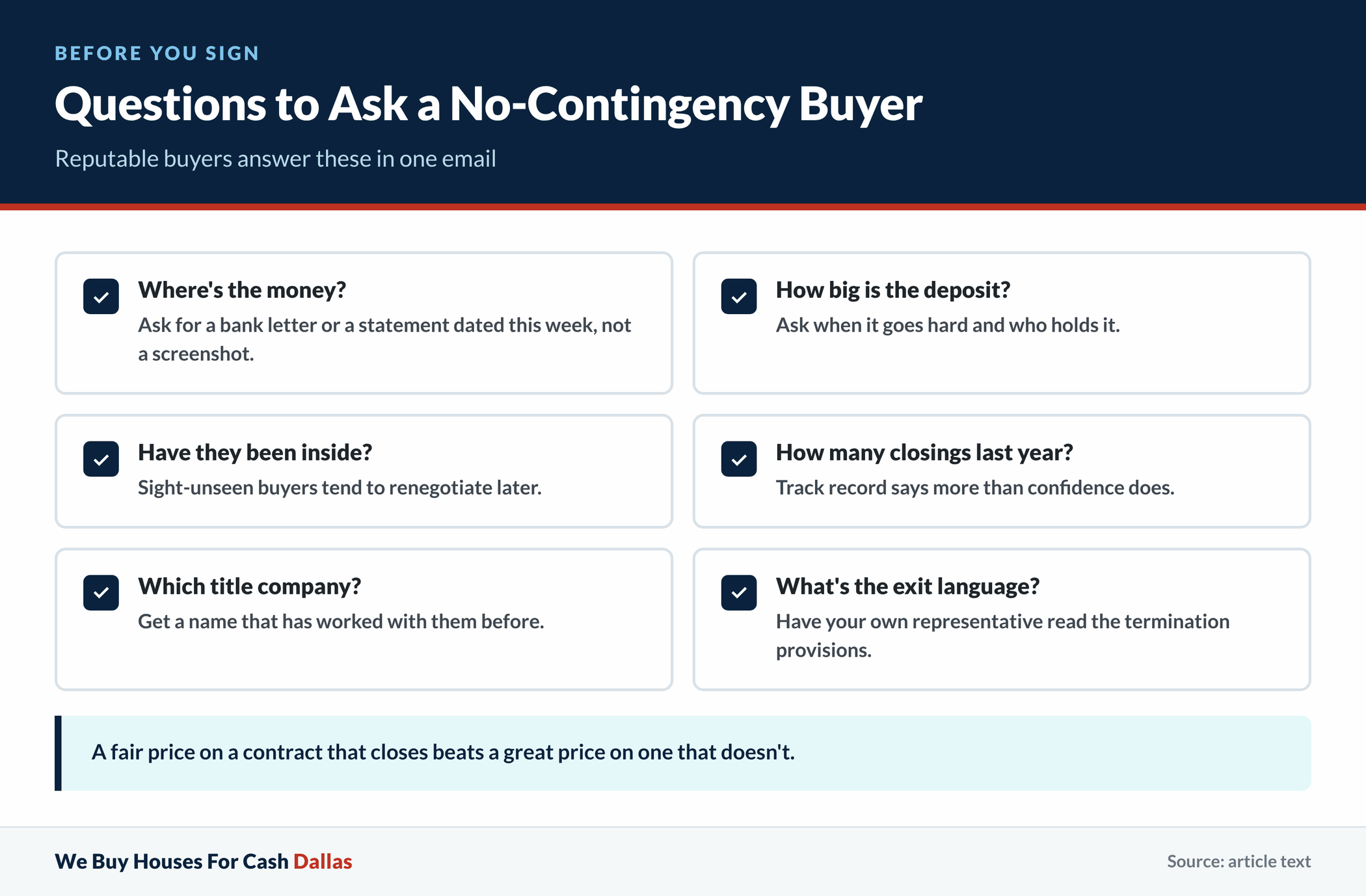
Get this wrong and you lose six weeks, a moving deposit, and whatever leverage your listing had when it was fresh.
Start with money. Where is it, who’s holding it, and can I see a statement dated this week? A screenshot of an account balance is not proof of funds. Bank letters and recent statements are.
Then ask about the deposit. How much is the buyer putting up, when does it go hard, and who holds it? In my experience, earnest money that becomes non-refundable at signing is worth more to you than a larger deposit that stays refundable for twenty days.
Have they been inside? Did they pull permits or look at the sewer scope? A buyer making an offer with no contingencies sight-unseen is a buyer who will find a reason to renegotiate once they finally walk through.
How many closings last year? Will they give you the name of a title company that’s worked with them? Reputable buyers answer these in one email without hesitating, so the ones who deflect are telling you something.
And ask about the exit language. Even a contract with no contingencies has termination provisions buried in it somewhere. Have someone who represents you, not the buyer, read those paragraphs before you sign.
One pattern I keep seeing: sellers who negotiate hard on price and barely glance at terms. Terms are where a sale lives or dies. A fair price on a contract that closes beats a great price on one that doesn’t.
Should You Accept a No Contingencies Offer on Your Home?
I used to think an offer with no contingencies was automatically the strongest one on the table. It isn’t. The strength lives in the buyer’s ability to perform, and the contract language is just a reflection of that.
So how do you decide? Weigh what certainty is worth to you right now. If you’re carrying two mortgage payments, managing a property from another state, or facing a hard deadline, the value of a guaranteed close is enormous. If your house is in good shape and you’ve got six months of runway, list it and keep your protections.
Also consider condition. Properties with deferred maintenance, fire damage, dated systems, or tenant issues rarely survive a traditional inspection period intact. Selling with no contingencies to a buyer who already knows what they’re taking on can net you more than a retail sale that gets gutted by repair credits.
A couple in Plano called me after his transfer came through with five weeks’ notice. Their garage was still full of unopened boxes from the last move, so the thought of a 35-day listing period followed by escrow made the whole thing impossible. We closed with no contingencies, they took what fit in the truck, and I handled the boxes.
When you want a straight read on whether a direct sale makes sense for your situation, We Buy Houses For Cash Dallas will walk through the numbers with you honestly.
Frequently Asked Questions About Selling a House with No Contingencies
Can a Seller Back Out of a Contingent Contract?
Usually not, at least not freely. Contingencies are written to protect the buyer, so they give the buyer exit rights, not you. Your ability to walk away typically depends on a specific seller-side clause in your agreement, a buyer who misses a deadline, or mutual release, and the rules differ by state. Have a real estate attorney in your state read your contract before you assume you can cancel.
Does a Buyer Still Get to Inspect the House?
Yes, in most cases, and you should let them. Waiving the contingency removes their right to demand repairs or exit based on what they find; it doesn’t block them from hiring an inspector for their own information. Any buyer who looks carefully before closing is far less likely to come back asking for a price reduction later.
Will I Get Less Money Selling with No Contingencies?
Often, yes. Buyers who take on all the risk expect compensation for it, so the offer usually lands below what a well-prepared retail listing might fetch with full buyer protections in place. What you’re buying with that difference is speed, a firm closing date, and no second round of negotiations after an inspection report lands.
Do I Still Have to Disclose Problems with the Property?
Absolutely. Disclosure duties come from state law and are separate from whatever the buyer waived in your agreement. A contract with no contingencies gives you zero cover for hiding a known roof leak, foundation issue, or past flooding. Fill out your disclosure form completely and keep a copy.
What If the Buyer’s Appraisal Comes in Low?
When the buyer waived the appraisal protection, the shortfall is their problem to solve with their own money. That only works if they genuinely have the cash on hand, which is why verified proof of funds matters so much before you sign. With an all-cash buyer, no bank valuation is ordered at all, so the question never arises.
How Fast Can a Sale with No Contingencies Actually Close?
Two to three weeks is typical once title work is underway, and some close faster when the title search comes back clean and both parties are ready. The limiting factor is almost never the buyer; it’s how long your county and the title company take to process everything. Ask your closer for a realistic date before you commit to a move-out plan.
Is This the Right Choice for an Inherited Property?
It frequently is, especially when you live far away or share ownership with siblings. Inherited houses tend to carry deferred maintenance that invites heavy renegotiation in a traditional sale, and coordinating repairs across multiple heirs is its own headache. Just confirm the estate has legal authority to sell before signing anything, since probate requirements vary by state.
If you’re weighing an offer with no contingencies and want someone to look at it with you, we’re glad to help. No pressure, no obligation, and no hard feelings if you decide listing is the better path for your family.
How We Handle No Contingency Sales in Dallas
Our team buys houses across Dallas and North Texas with cash and no contingencies, so there’s no lender, no appraisal, and no financing clause to fall apart. In Veterans United’s local market data, Dallas metro homes recently spent a median of 64 days on the market.
If your property sits in a nearby suburb, we also work as cash home buyers in Garland and across the rest of the state.
Talk With Us Before You Sign a No Contingency Offer
A second set of eyes on an offer with no contingencies can save you weeks. If you’d like to compare what you’re holding with a direct sale, get in touch with our team and share a few details about the house.
You can also fill in the short form below, and we’ll follow up.